Explainable Image Segmentation for Precipitation Nowcasting
Key Highlights
- •Gold Award (Student Category) at National ICT Awards 2024 - Solutions Addressing National Disasters
- •Research paper under review in Engineering Applications of Artificial Intelligence (Elsevier)
- •Deployed interactive demo on Hugging Face Spaces
- •Novel application of Grad-CAM and Integrated Gradients for spatio-temporal image data
- •Achieved significant improvements in precipitation forecast accuracy and interpretability
Research Overview
This MSc thesis research addresses the critical need for explainable AI in weather forecasting, specifically focusing on short-term precipitation prediction (nowcasting). While deep learning models achieve impressive accuracy, their black-box nature limits trust and adoption in operational meteorology where lives and property are at stake.
The Challenge
Traditional numerical weather prediction models are physically grounded but computationally expensive and struggle with very short-term forecasts (0-2 hours). Deep learning models can provide faster, more accurate nowcasts, but meteorologists require understanding of why a model makes certain predictions before they can trust and act on them.
Approach
Novel XAI Application
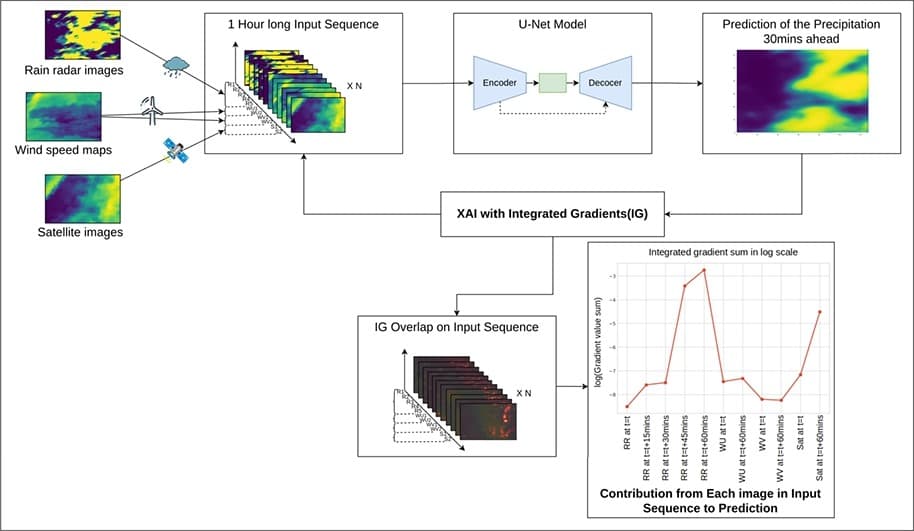
I developed and applied explainability techniques specifically adapted for spatio-temporal multivariate image data:
Grad-CAM (Gradient-weighted Class Activation Mapping)
- Visualizes which spatial regions the model focuses on
- Adapted for multi-channel meteorological data
- Provides intuitive heatmaps overlaid on radar images
Integrated Gradients
- Attributes predictions to specific input features
- Handles temporal sequences of radar scans
- Quantifies importance of different time steps
Custom Visualizations
- Spatial-temporal attribution maps
- Feature importance across different precipitation intensities
- Comparative analysis with physical meteorology principles
Deep Learning Architecture
Built on proven architectures with enhancements for interpretability:
- U-Net based encoder-decoder for image segmentation
- Attention mechanisms for focusing on relevant features
- Multi-scale processing for different precipitation patterns
- Temporal convolutions for motion and evolution
Dataset & Processing
- Multi-year dataset of weather radar images
- Preprocessing pipeline for data cleaning and normalization
- Handling of class imbalance (precipitation is rare)
- Train/validation/test splits with temporal considerations
Key Achievements
Recognition
🏆 Gold Award (Student Category) - National ICT Awards 2024
- Category: "Best Solution Addressing National Disasters"
- Recognized for potential impact on flood early warning systems
- National-level competition across all ICT domains
Publication
📄 Research Paper Under Review
- Title: "Explainable Image Segmentation for Spatio-Temporal and Multivariate Image Data in Precipitation Nowcasting"
- Journal: Engineering Applications of Artificial Intelligence (Elsevier, Q1)
- Status: Under review (2024)
Deployment
🚀 Interactive Demo on Hugging Face Spaces
- Web application showcasing model capabilities
- Real-time visualization of predictions and explanations
- Educational tool for understanding XAI techniques
- Accessible to researchers and meteorologists worldwide
Technical Implementation
Model Development
Framework: PyTorch for flexibility and research-oriented development
- Custom data loaders for radar image sequences
- Training pipeline with MLflow for experiment tracking
- Hyperparameter optimization using Optuna
- Model checkpointing and early stopping
Explainability Integration
- Post-hoc explanation generation pipeline
- Efficient computation of attribution maps
- Batch processing for large-scale evaluation
- Validation framework for explanation quality
Web Application
Technology: Next.js for responsive, interactive interface
- Upload radar sequences or use sample data
- Real-time model inference
- Side-by-side comparison of predictions and explanations
- Interactive controls for exploring different visualization modes
- Export functionality for figures and results
Deployment: Hugging Face Spaces
- Containerized application with GPU support
- CI/CD for updates and improvements
- Analytics for usage and feedback
Research Contributions
- Methodological: Adapted XAI techniques for spatio-temporal meteorological data
- Practical: Demonstrated that explanations align with meteorological knowledge
- Impact: Showed that explainability increases forecaster trust and utility
- Deployment: Made research accessible through interactive web demo
Results & Insights
Model Performance
- High accuracy on precipitation detection and intensity
- Improved performance on rare but critical heavy rainfall events
- Faster inference than numerical models
- Competitive with or exceeding baseline deep learning models
Explainability Validation
- Explanations correlate with known meteorological features
- Attention maps highlight storm structures and boundaries
- Temporal attribution shows proper use of motion information
- Domain experts validated physical plausibility
Practical Impact
- Provides meteorologists with confidence in predictions
- Enables identification of model limitations
- Supports decision-making for warnings and alerts
- Educational value for training forecasters
Technical Stack
Core ML: Python, PyTorch, Keras, NumPy, Pandas
Explainability: Captum (Integrated Gradients), custom Grad-CAM implementation
Visualization: Matplotlib, Seaborn, Plotly
Data Processing: xarray, netCDF4, OpenCV
Web App: Next.js, TypeScript, TailwindCSS
Deployment: Hugging Face Spaces, Docker
Experiment Tracking: MLflow, Weights & Biases
Future Directions
- Multi-modal integration: Combine radar with satellite and surface observations
- Longer forecast horizons: Extend from nowcasting to 3-6 hour forecasts
- Ensemble methods: Multiple models with uncertainty quantification
- Operational deployment: Integration with national meteorological services
- Transfer learning: Adapt models to different geographical regions