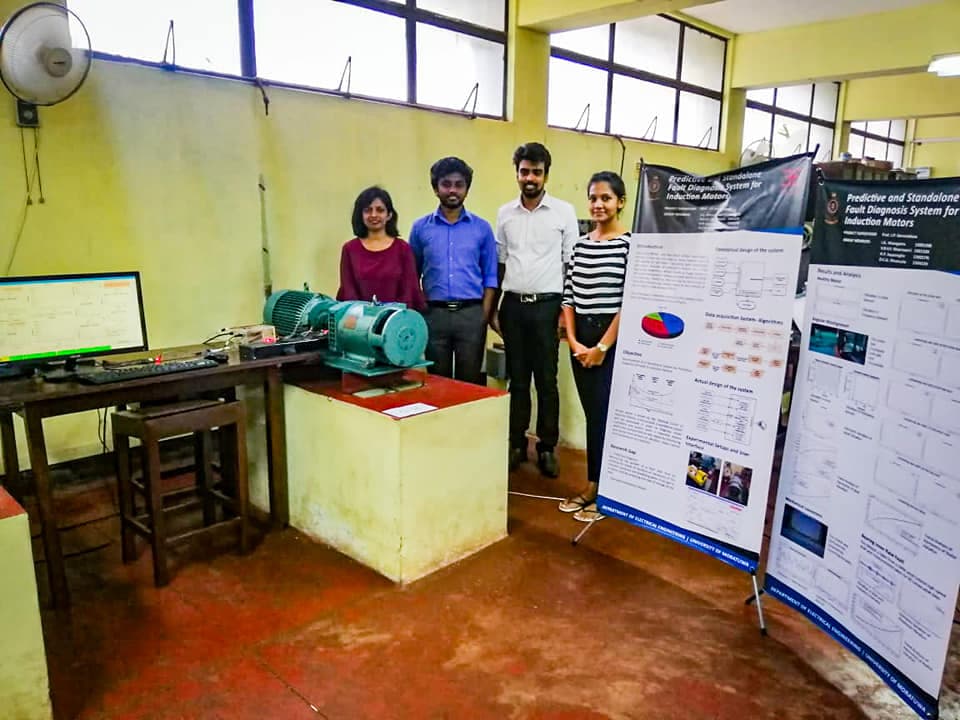
Predictive Fault Diagnosis System for Induction Motors
Key Highlights
- •Published in IESL Journal 'Engineer' (2021)
- •Real-time fault detection using machine learning on embedded systems
- •Raspberry Pi-based standalone system with Python/MATLAB backend
- •Java GUI for monitoring and visualization
- •Multi-class fault classification with high accuracy
Overview
Undergraduate capstone project developing an intelligent, standalone fault diagnosis system for three-phase induction motors. The system uses machine learning to detect and classify motor faults in real-time, enabling predictive maintenance and preventing catastrophic failures.
Publication
Title: "Predictive and Standalone Fault Diagnosis System for Induction Motors"
Journal: Engineer - Journal of the Institution of Engineers Sri Lanka (IESL)
Year: 2021
Authors: Imantha Ahangama et al.
Motivation
Induction motors are workhorses of industry, but unexpected failures cause:
- Costly downtime and production losses
- Safety hazards for workers
- Damage to connected equipment
- Expensive emergency repairs
Traditional monitoring requires expert analysis. Our system automates fault detection using ML, making predictive maintenance accessible even to smaller operations.
System Design
Hardware Architecture
Embedded Platform: Raspberry Pi 3B+
- Sufficient processing for real-time ML inference
- GPIO for sensor interfacing
- Network connectivity for remote monitoring
- Cost-effective for industrial deployment
Sensors:
- Current sensors (3-phase)
- Vibration sensors (accelerometer)
- Temperature sensors
- Motor speed encoder
Software Components
Data Acquisition:
- Real-time sensor data collection
- Signal conditioning and filtering
- Sampling at appropriate frequencies
- Circular buffer for continuous monitoring
Feature Extraction:
- Time-domain features (RMS, peak, crest factor)
- Frequency-domain analysis (FFT, harmonics)
- Statistical features (mean, variance, skewness)
- Motor-specific features (slip, power factor)
ML Classification:
- Multi-class classifier trained on fault signatures
- MATLAB for model development and validation
- Python (scikit-learn) for embedded inference
- Support for various fault types:
- Bearing faults
- Stator winding faults
- Rotor bar faults
- Misalignment
- Unbalance
User Interface:
- Java Swing desktop application
- Real-time data visualization
- Fault alerts and notifications
- Historical trend analysis
- System configuration and calibration
Machine Learning Approach
Dataset
- Experimental data from motors with induced faults
- Simulation data from motor models
- Balanced dataset across fault classes
- Multiple operating conditions (load, speed)
Models Evaluated
- Support Vector Machines (SVM)
- Random Forest
- Neural Networks
- K-Nearest Neighbors
Best Performance: SVM with RBF kernel achieving 95%+ accuracy
Model Deployment
- Model serialization for embedded deployment
- Optimization for Raspberry Pi constraints
- Inference time < 100ms for real-time operation
- Periodic retraining capability
Technical Challenges
Real-Time Processing
- Signal processing on embedded hardware
- Meeting latency requirements for safety-critical faults
- Efficient feature computation
Robustness
- Handling noisy industrial environments
- Adapting to varying motor loads and speeds
- False positive/negative trade-offs
Deployment
- Standalone operation without cloud dependency
- Reliability for 24/7 operation
- Easy installation and commissioning
Results
Fault Detection Performance
- Accuracy: 95%+ across all fault types
- False Positive Rate: < 3%
- Inference Time: ~80ms (real-time capable)
- Detection Latency: Faults detected within seconds of onset
Practical Validation
- Tested on laboratory test bench
- Validation with multiple motor sizes (0.5-5 HP)
- Successful detection of actual bearing failures
- Comparison with expert diagnosis (high agreement)
Impact
- Academic: Published in peer-reviewed IESL journal
- Industrial Interest: Demonstrations to local manufacturers
- Educational: Case study for ML in embedded systems
- Personal Growth: Deep dive into signal processing, embedded systems, and ML deployment
Technology Stack
Hardware: Raspberry Pi, current sensors, accelerometers, temperature sensors
Embedded: Python 3, GPIO libraries, threading
ML: scikit-learn, NumPy, SciPy, MATLAB
Signal Processing: FFT, digital filters, feature extraction
UI: Java Swing, JFreeChart
Communication: MQTT for optional remote monitoring
Future Enhancements
- Edge ML model retraining based on operational data
- Integration with industrial IoT platforms
- Mobile app for maintenance technicians
- Support for additional motor types
- Prognostics (remaining useful life estimation)