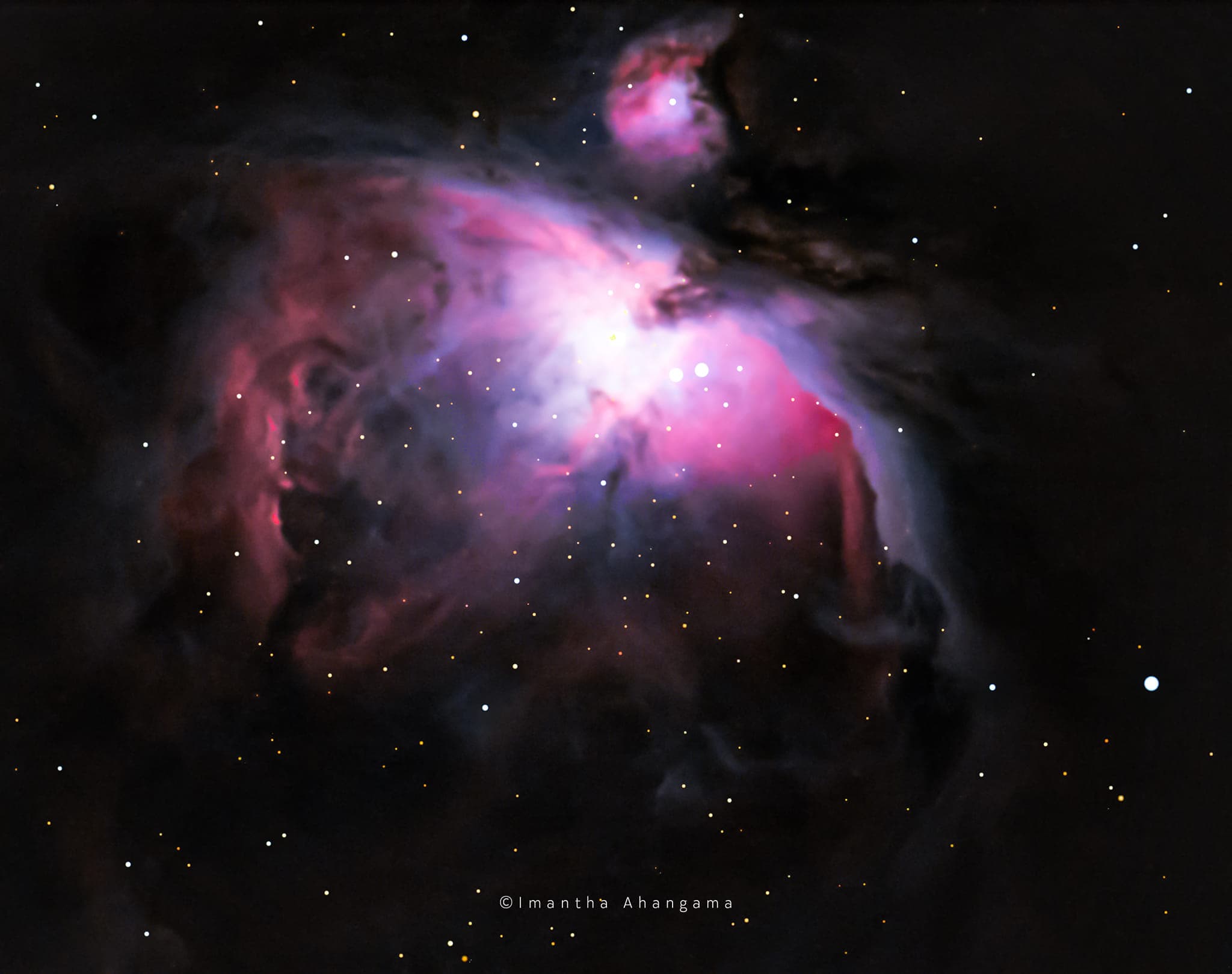
Orion Nebula (M42)
Target
Messier 42 (Orion Nebula)
Date
January 15, 2024
Location
Bortle 4, California
Gear
William Optics RedCat 51, ZWO ASI2600MC Pro
Exposure
300s
Integration
6 hours (72 x 300s)
The Great Orion Nebula
The Orion Nebula (M42) is one of the most spectacular deep sky objects visible from Earth. Located in the sword of Orion, this stellar nursery is approximately 1,344 light-years away and spans about 24 light-years across.
About This Image
This image captures the vibrant colors and intricate structures of the Orion Nebula:
- Core Region: The bright central area contains the Trapezium Cluster, a group of young, massive stars whose intense radiation illuminates the surrounding gas
- Red Emission: Hydrogen-alpha emission dominates, giving the nebula its characteristic red color
- Blue Reflection: Areas where starlight scatters off dust particles
- Dark Lanes: Dense dust clouds that obscure background stars
Imaging Details
Equipment
- Telescope: William Optics RedCat 51 (250mm f/4.9)
- Camera: ZWO ASI2600MC Pro (cooled to -10°C)
- Mount: Sky-Watcher EQ6-R Pro
- Guiding: ZWO ASI120MM Mini + 30mm guide scope
- Filter: Optolong L-eXtreme (Ha/OIII)
Acquisition
- Total Integration: 6 hours
- Light Frames: 72 x 300 seconds (ISO 800)
- Calibration: 30 darks, 30 flats, 30 bias
- Date: January 15, 2024
- Location: California (Bortle 4)
- Temperature: 45°F
Processing Workflow
- Calibration: Dark, flat, and bias frame application in PixInsight
- Stacking: Weighted batch preprocessing with outlier rejection
- Gradient Removal: Dynamic background extraction
- Deconvolution: Careful sharpening of nebula details
- HDR Composition: Blending for core details
- Color Calibration: Photometric color calibration
- Noise Reduction: TGV denoise on chrominance
- Final Stretch: Masked stretch to preserve core
Scientific Interest
The Orion Nebula is a cosmic laboratory for studying star formation:
- Active star formation occurring right now
- Protoplanetary disks (proplyds) visible with Hubble
- Diverse population of stellar masses
- Ionization structures from massive stars
- Molecular cloud interactions
Visual Observation
M42 is visible to the naked eye as the middle "star" in Orion's sword. Through binoculars or a small telescope, the nebulous nature becomes apparent. Larger telescopes reveal incredible detail in the gas structures and numerous embedded stars.
Personal Notes
The Orion Nebula never gets old—I've imaged it dozens of times and each time reveals new details. This particular session benefited from exceptional seeing conditions, allowing 5-minute exposures with minimal star trailing. The challenge with M42 is always the extreme dynamic range between the bright core and faint outer regions, requiring careful exposure planning and HDR techniques.